Lenders and development finance institutions
Checking a borrower’s assessment against the International Finance Corporation Performance Standards or the Equator Principles means reading every chapter for the evidence behind each requirement, and the result depends on who did the reading. EcoSphere applies the same standard to every review and shows the reviewer where the evidence is.
The submission is uploaded and the standards chosen. For each requirement the artificial intelligence quotes the passages it finds, with the document and paragraph, and the reviewer records the finding. Gaps become the action plan and the review ends in a Gap Assessment Report exported to Word. The same record serves annual monitoring and close-out.
Setting up a review against lender standards
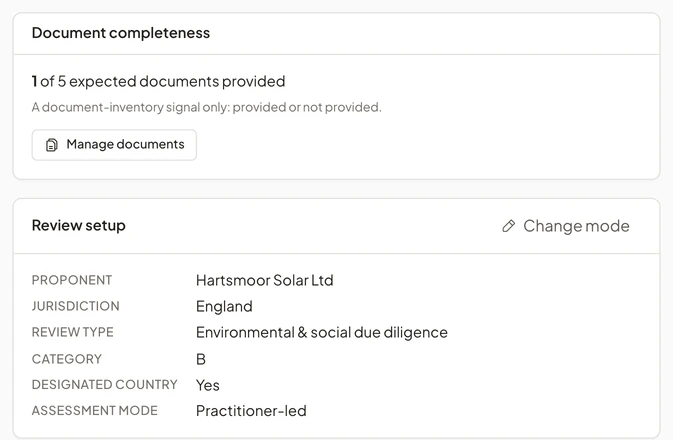
The review names the borrower, the review type and the standards, and holds the category the reviewer records with its reasons.
The standards held in the platform include the International Finance Corporation Performance Standards, the Equator Principles, the Common Approaches of the Organisation for Economic Co-operation and Development and the Export Finance Australia review checklist. Each requirement cites its source. The overview also shows which of the documents the review expects have been provided.
The evidence for each requirement
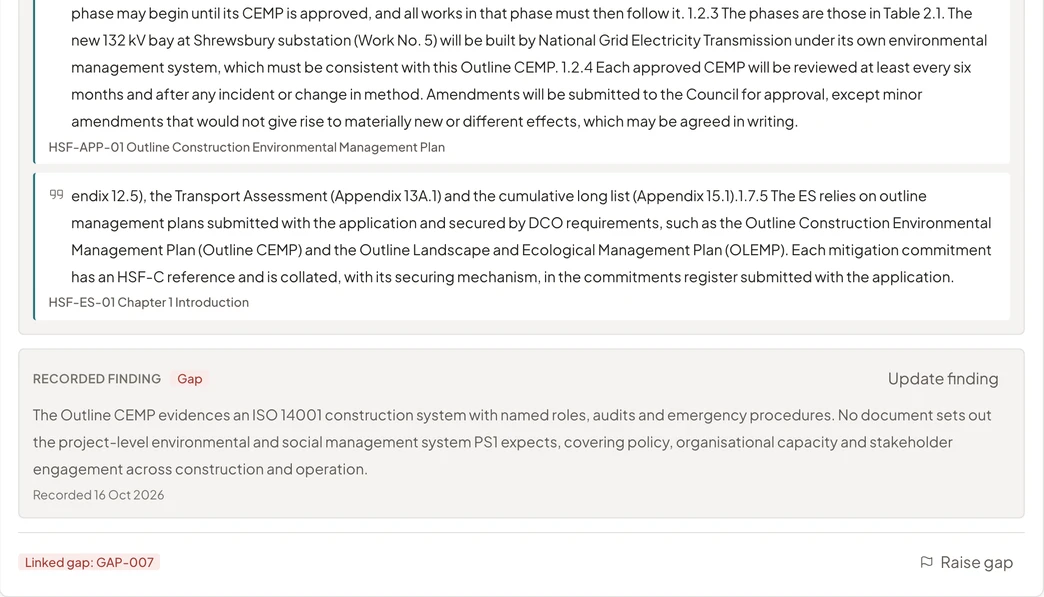
For each requirement the artificial intelligence reports what it found in the submission, cites the paragraphs it relied on and quotes the passages with the document each came from.
The reviewer reads the quoted passages, records the finding (no gap, gap, observation, information request or not applicable) with a note, and gives a reason wherever the finding departs from what the evidence review reported. The record keeps both.
Gaps and the action plan
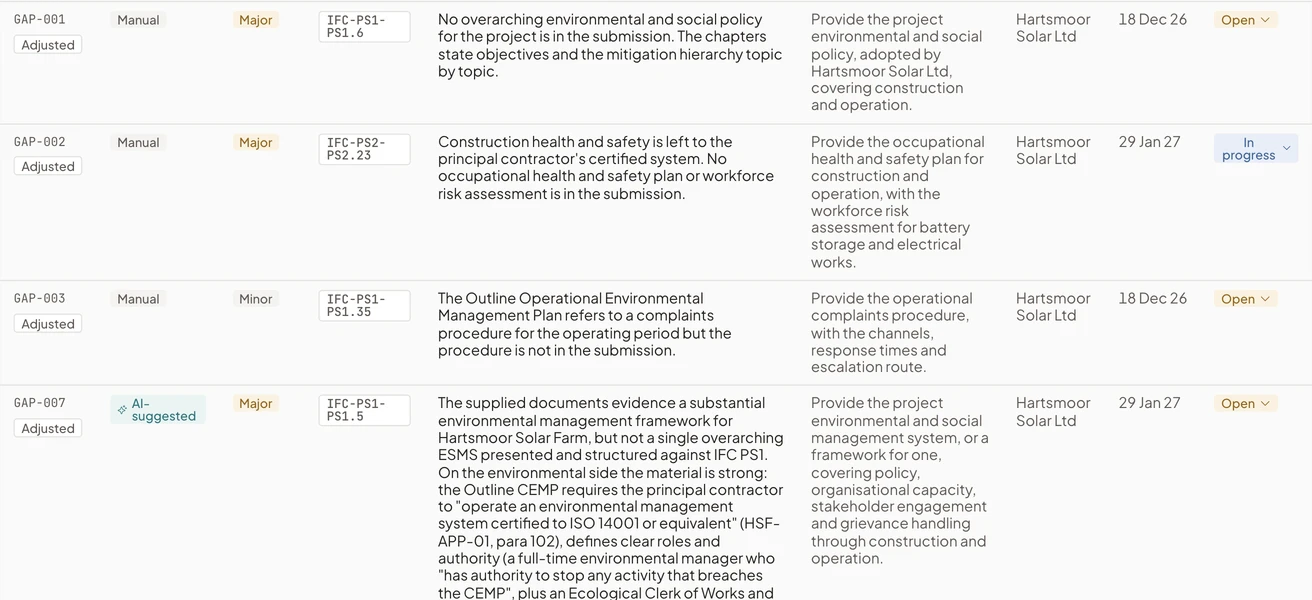
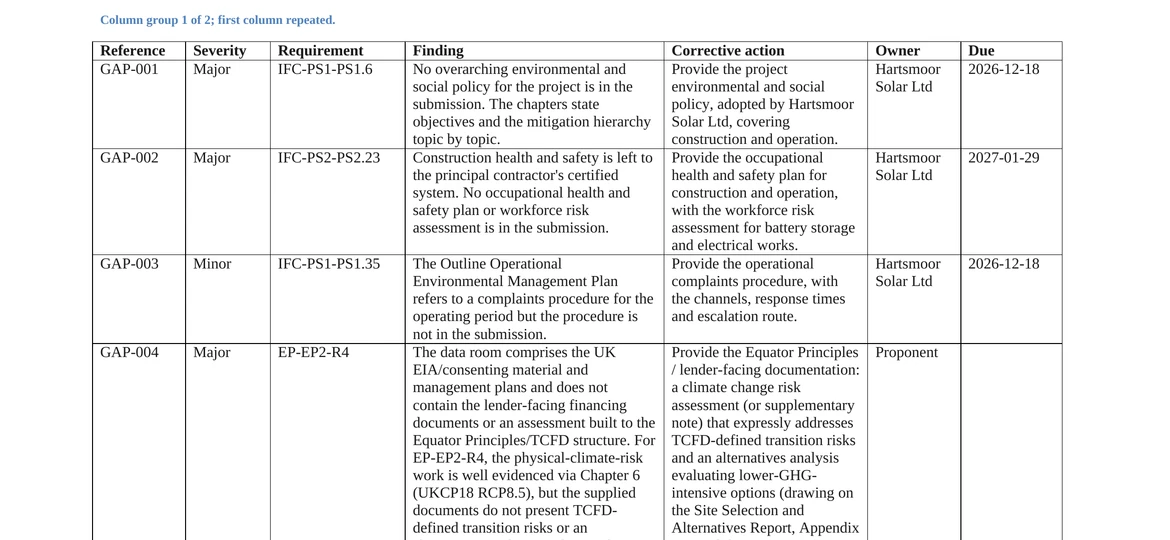
A gap raised from a requirement carries its severity, the corrective action, an owner and a due date.
The gap register is the environmental and social action plan. Each gap moves from open to in progress, closed and verified, and the register exports to Word and to a workbook for the borrower and the lender group.
The review checklist
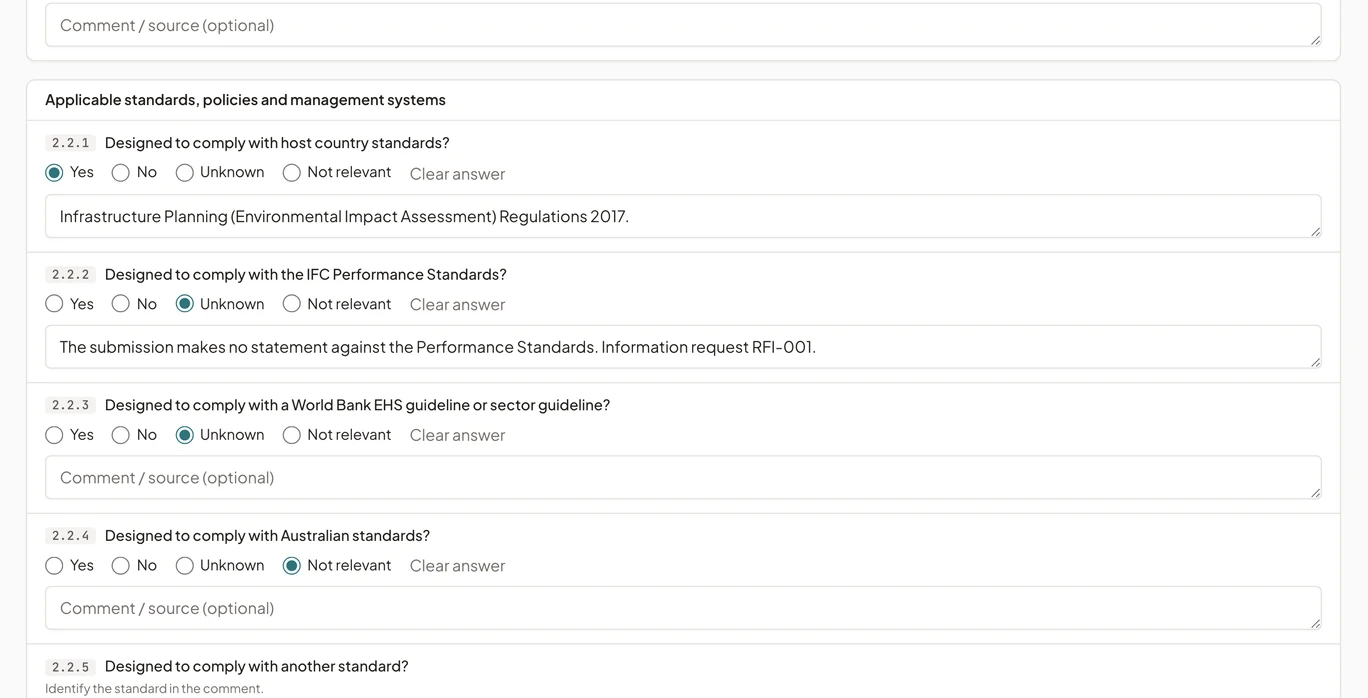
The lender’s own review checklist is answered on the review, and the answers that need attention are flagged.
A checklist template holds the questions the lender’s procedure asks at each review. Each answer is recorded with who gave it and when, and the checklist is marked complete when the reviewer has been through it.
The Gap Assessment Report
The report is assembled from the review, approved by a named reviewer and exported to Word.
The gap register is assembled into it as the action plan, with the Equator Principles status table and the basis of the review, and the narrative sections are written in Word after export. The report cannot be submitted for approval until every requirement has a finding.
Annual monitoring and action plan tracking
A review set up as annual monitoring or action plan tracking runs on the same record.
The reviewer uploads the year’s monitoring reports, the artificial intelligence finds the evidence for each requirement again, and the gaps raised at due diligence are closed and verified in the register as the borrower delivers the action plan.
Related pages
See EcoSphere in a demo
A walkthrough on a sample review.
We show a submitted assessment reviewed against a standard, from the evidence for each requirement to the Gap Assessment Report.